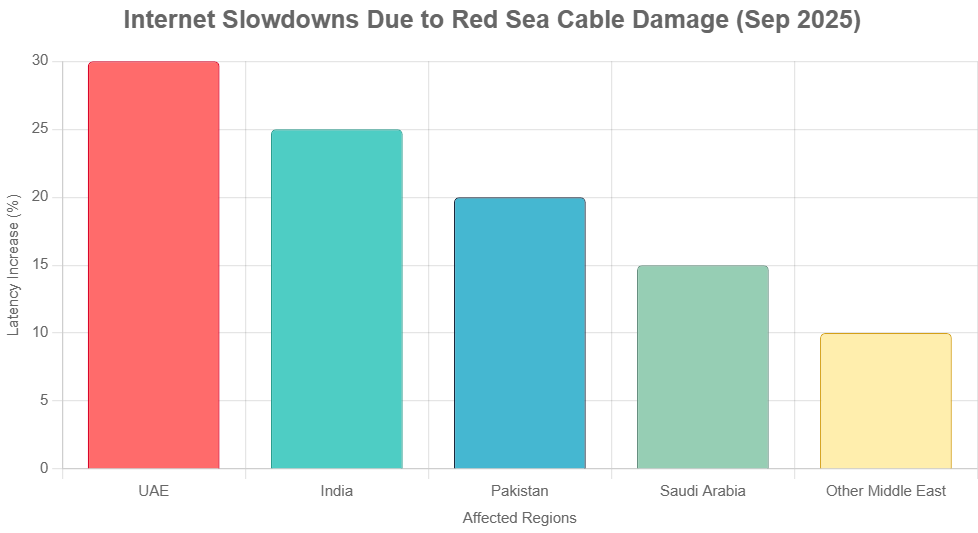
Ever had your video call freeze mid-sentence or your game lag out? That’s exactly what some folks in the UAE (and beyond) are dealing with right now. Residents are facing slow internet across UAE, all thanks to a juicy fiasco under the waves: Red Sea undersea cable damage.
Over the weekend of September 6, several submarine cables slicing through the Red Sea were severed, causing noticeable slowdowns across the Middle East, South Asia, and parts of Africa. These include heavy-hitters like SMW4 (South East Asia–Middle East–Western Europe 4), IMEWE (India–Middle East–Western Europe), FALCON GCX, and even the Europe India Gateway cable.
While no country went completely offline, the hit was still real. Internet users in places like India, Pakistan, and of course, the UAE with its Du and Etisalat networks—started complaining about sluggish browsing, choppy VPN connections, and delays when reaching cloud platforms.
For the slow internet in UAE and other regions, experts are pointing fingers mainly at an accidental anchor drag by a commercial vessel. Because of how shallow the seabed is near some cable routes—especially around the Bab el-Mandeb Strait—a dropped anchor could easily yank cables out of action. Roughly 30% of these types of incidents each year are caused by ship anchors. (AP – turn0news16)
In another corner of the world, conflict shadows loom. Concerns about Houthi rebel attacks have circulated, especially given earlier maritime skirmishes. The rebels have denied targeting undersea infrastructure, though Yemen’s internationally recognized government suggests otherwise. It’s murky; nothing’s confirmed.
Fixing the cables is no short gig. Engineers must first locate the break, then dispatch a specialized ship to raise the damaged section, splice it back together, and test it—all of which can take two to six weeks, depending on weather, location, and ship availability. A professor at Amity University in Dubai, Dr. Sarath Raj, emphasized that it’s a lengthy and delicate operation. (The National – turn0search1)
Major cloud providers aren’t immune either. Microsoft Azure confirmed increased latency, especially for services routed through the Middle East. They’ve started rerouting traffic, but expect things to be a bit slow until repairs are done. (Reuters – turn0news22; Tom’s Hardware – turn0news20). Linode and others echoed similar woes, blaming redundancy backups now overloaded.

