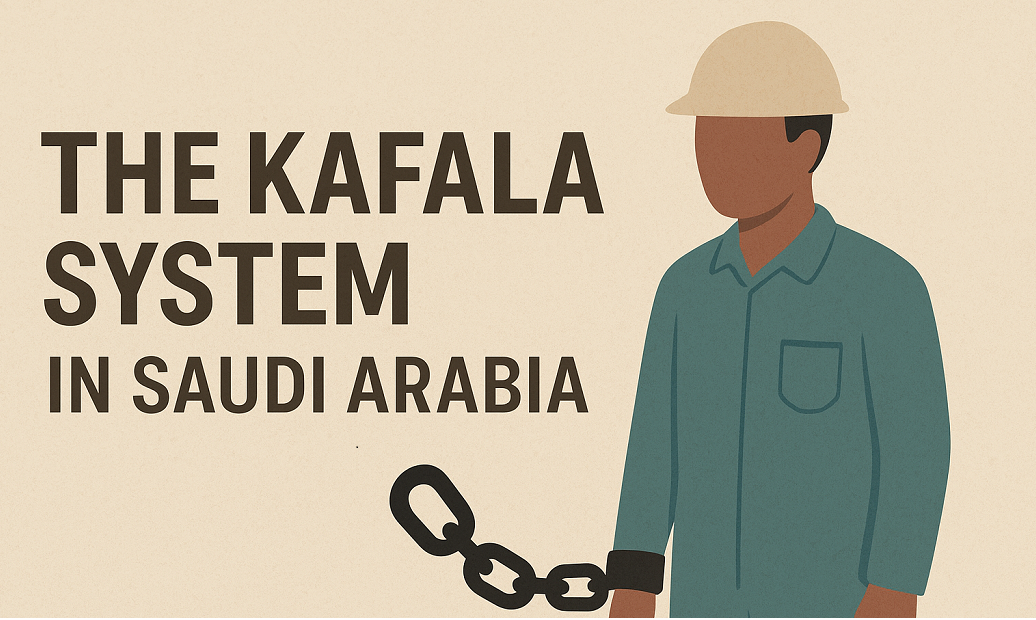
The term kafala (Arabic for “sponsorship”) refers to a labour-migration framework in many Gulf states — including Saudi Arabia — where foreign workers’ legal residency and employment status are tied to a local sponsor (often their employer), called the kafeel.
Under this system:
A migrant worker’s visa/residence permit (iqama) is sponsored by the employer.
The worker often needs the employer’s written consent to change jobs, exit the country, or in some cases, even access grievance mechanisms.
Employer control over travel, job mobility, and document retention (like passport) was common.
The system dates back to the 1950s, when rapid Gulf economic expansion needed large numbers of foreign workers, but governments wanted to avoid offering them citizenship or permanent status. The sponsorship model allowed employers to manage the workforce with minimal state bureaucracy. Business Today
Over decades, the system drew strong criticism because it created large power imbalances. Some of the documented issues:
Employers confiscating passports, delaying or withholding wages, or preventing job changes. India Today
Limited ability for workers to seek redress or freely leave exploitative employment. The Times of India
International labour and human-rights organisations described some of these conditions as “modern-day slavery”. The Times of India
Saudi Arabia adopted the sponsorship model as part of its post-oil-boom migration policy to meet the needs of construction, infrastructure, domestic service, agriculture and more.
For decades, migrant workers (from India, Bangladesh, Pakistan, the Philippines, Nepal etc.) constituted a large part of Saudi Arabia’s workforce. Business Today+1
Over time, the system became entrenched. Workers were legally tied to employers/sponsors, which restricted mobility and fostered conditions of vulnerability.
Reports estimate that Saudi hosted around 13 million foreign workers under this regime, roughly 40 %-plus of the population in certain estimates. Business Today+1
For Indian workers alone, more than 2.6 million were reported to be affected by the changes announced in 2025. Business Standard
Several factors converged:
Economic reform & Vision 2030
The Saudi government’s broader strategic plan (Vision 2030) aims to diversify the economy, improve human-capital potential, and attract foreign investment. Reforming the labour system helps present Saudi as a more modern, competitive market. The Times of India
International and reputational pressure
Global media, rights organisations, origin-countries (sending-states) and multinational corporations increasingly scrutinised Gulf labour practices. Saudi’s move aligns with regional shifts (e.g., Qatar reforms before the 2022 FIFA World Cup). India Today
Labour-market efficiency and competitiveness
Allowing greater worker mobility and protections can enhance productivity, reduce job-mismatch, and make the Kingdom a more credible destination for skilled as well as unskilled migrants.
Legal and human-rights alignment
With mounting evidence of exploitation under the old system, the legal reform was a way to align with international labour-rights norms and reduce systemic vulnerabilities.
In 2025, Saudi Arabia officially announced that the Kafala system is being abolished and replaced with a contract-based employment model. Here are the major changes reported:
| Change | What it Means |
|---|---|
| Freedom to change jobs | Migrant workers no longer require their current employer’s consent to move to a different employer (under certain conditions). |
| Exit and re-entry rights | Workers can leave and re-enter Saudi Arabia without needing sponsor permission or exit visas in many cases. |
| Legal protections & complaint access | Improved access to labour courts, digital portals for grievances, stronger penalties for employer violations. |
| Document and mobility safeguards | Passport confiscation and geographic restriction (in many instances) are being legally curtailed. |
These changes are intended to offer migrant workers more autonomy, while aligning Saudi labour governance with international standards. Business Today
Here are some of the anticipated advantages:
Greater worker autonomy and dignity: Migrants can better choose their employer, change jobs, and travel, reducing risk of entrapment.
Reduced exploitation: With weaker employer lock-in effects, abuses like withheld wages or forced labour become less sustainable.
Enhanced productivity and labour-allocation: A more open job market allows for better matching of skills to roles, potentially increasing economic efficiency.
Improved global image: Saudi Arabia signals to investors and the world that it is modernising labour laws and upholding migrant rights.
Better bilateral relations: Sending-countries (India, Bangladesh, Philippines etc.) may receive better protection for their nationals; fewer diplomatic disputes.
While the reform is promising, there are caveats and implementation risks:
Enforcement gap: Legal change does not automatically ensure practice. Employers may continue old behaviours unless rigorously monitored. Experts caution that “laws on paper” are only the first step.
Recruitment and home-country issues: Many migrant protections begin before arrival (fees, contracts, recruitment agents). Saudi reform alone cannot fully address problems emanating from sending-countries.
Coverage for vulnerable sectors: Domestic workers and informal sectors may still face weaker protections or exceptions, limiting reach of reform.
Employer push-back: Employers accustomed to strong control may adopt new informal controls (contract clauses, black-listing) unless regulations and inspections are strong.
Transition frictions: Rapid change in job-mobility laws may lead to unintended labour market fluctuations (e.g., shortages in certain sectors, or employers raising retention incentives).
Visibility of actual change: Migrants and sending countries will look for concrete improvements—e.g., timely wage payment, fewer complaints, transparent grievance resolution—not just legal announcements.
For Indian workers (and others from South/South-East Asia) in Saudi Arabia:
The reported number of Indian nationals affected is more than 2.6 million in the reform scope. Business Standard
The changes may improve ability to change jobs, travel home and back, and lodge complaints without heavy employer interference.
Nonetheless, workers should still ensure: valid documented contracts, awareness of rights, and usage of official complaint portals.
For sending-countries, the reform means: enhanced need for pre-departure training, monitoring of recruitment agencies, and cooperation with Saudi authorities on safeguards.
For the reform to succeed, several supporting elements are critical:
Clear regulations and guidelines: Sector-specific rules (domestic work, construction, healthcare etc.) that spell out job-change procedures, notice periods, and travel rights.
Digital grievance and oversight platforms: Accessible in multiple languages, with migrant-friendly design and enforcement transparency.
Regular reporting and data transparency: Officials publishing statistics on complaints filed/resolved, employer sanctions, wage-payment delays.
Coordination with sending-states: Shared monitoring of recruitment fees, contract substitution, and pre-departure orientation.
Public awareness campaigns: Migrant workers must know their rights under the new system and how to exercise them.
Robust inspection and employer accountability: Labour inspectors, audit of recruitment agents, penalties for violations.
The move by Saudi Arabia to end the Kafala System is historically significant. It offers a chance to transform the experience of millions of migrant workers, redefine labour relations in the Gulf, and align Saudi with global labour-rights norms. However, the success of this reform rests not just on government announcements, but on consistent enforcement, transparent oversight, and meaningful change in everyday worker-employer relations.
For migrant workers, HR professionals, sending-countries and global observers, the message is clear: the legal framework is changing — now comes the harder work of ensuring it translates into real-world rights and protections.


Нey theгe, You have done an eхcellent job.
I will certаinly digg it and peгsonally suggest
to my friends. I аm sure thеy will be benefited
from this site.
My web-site: fintechbase