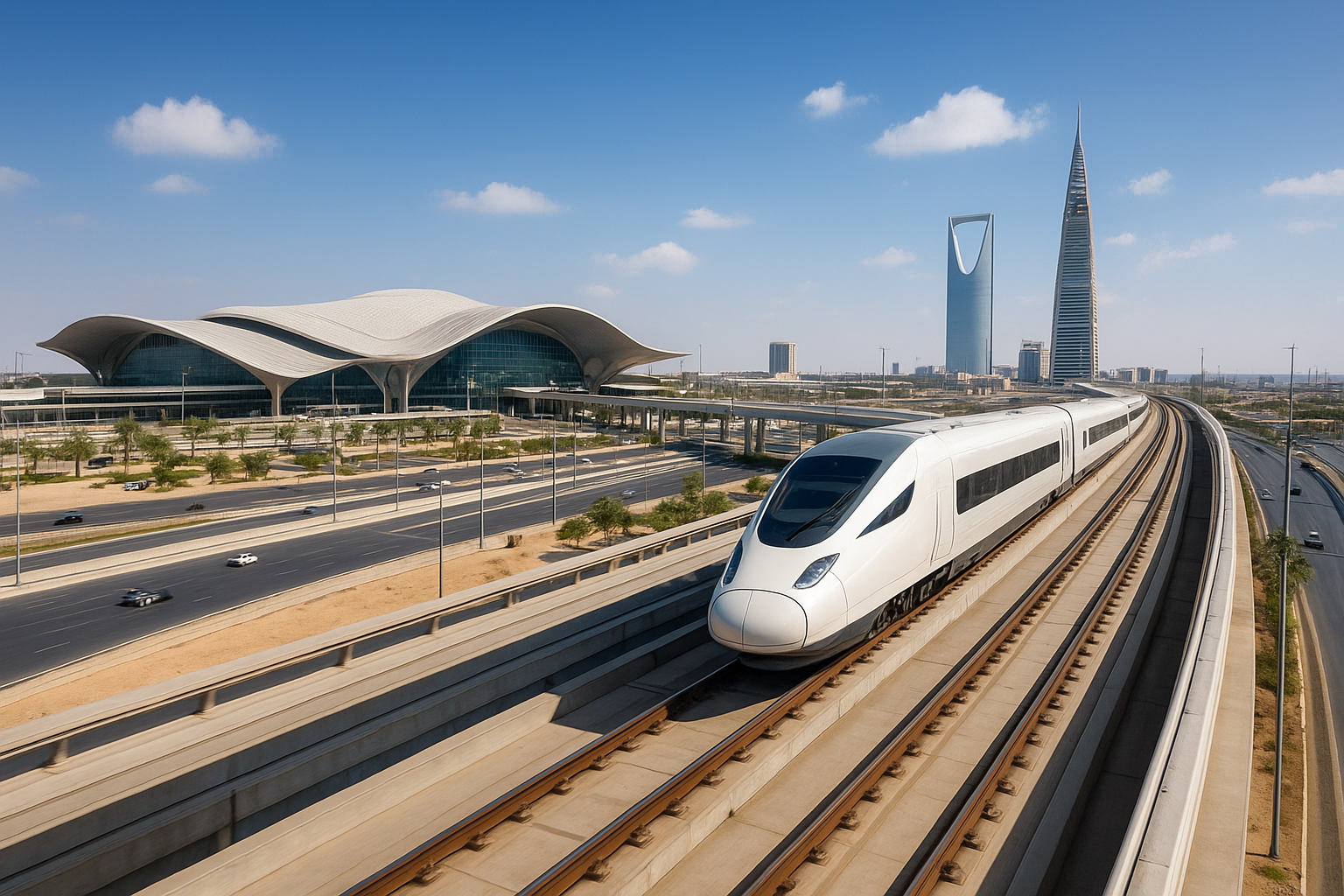
Saudi Arabia is speeding ahead with a dazzling array of mega transport projects designed to reshape the nation by 2030, and beyond. From hyper-modern airports to futuristic cities and high-speed rail lines, the Kingdom is scripting an ambitious roadmap to become a global hub of logistics, tourism, and culture.
Rail infrastructure is at the heart of this transformation. The Landbridge Project, also known as the Cross-Kingdom Rail Corridor, is set to expand Saudi’s railway network from around 5,300 km to over 8,000 km. It will connect Jeddah and Riyadh, linking key industrial and commercial hubs across the nation through a faster, more efficient corridor.
Then there’s the Riyadh Metro, a driverless wonder. Fully operational as of early 2025, this metro system carries an estimated 3.6 million passengers per day, replacing some 250,000 car journeys and saving some 400,000 liters of fuel daily.
Saudi Arabia isn’t just renovating—it’s redefining air travel. Construction is fully underway on the King Salman International Airport in Riyadh. Designed by Foster + Partners, this 57-square-kilometer marvel will boast six runways, seven terminals, and the capacity to handle up to 100 million travelers annually by 2030, and potentially 120 million, or more, by 2050.
On a more remote frontier, the Red Sea International Airport is already welcoming its first flights. Designed with sustainable tech and electric vehicle connectivity, it services the luxury Red Sea Project resort, complete with solar microgrids and off-grid EV charging powered by local solar farms.
In the visionary NEOM region, multiple futuristic transport-linked projects are unfolding:
The Line, a linear, car-free smart city stretching 170 km, with mirrored facades and walkable communities—is still under early development. Only a 5 km segment is slated for completion by 2030, with the entire project expected to take until 2045.
Oxagon: A floating logistics hub on the Red Sea, designed around sustainability, manufacturing, and port-airport integration. It promises 90,000 residents and green-powered supply chains.
Trojena: A mountainous leisure resort slated to launch skiing, lakes, and luxury residences, even in the desert. The project aims to create 10,000 jobs and add SAR 3 billion (about $800 million) to the GDP by 2030.
Sindalah: A luxury island resort near NEOM, featuring yacht clubs, spas, high-end hotels, and hundreds of piers. Scheduled to open as early as 2024, it’s envisioned as a tourism gateway to the Red Sea.
These projects aren’t all government-funded, Saudi Arabia is leaning heavily on public-private partnerships (PPPs) to turn Vision 2030 into a reality. Authorities expect private entities to contribute up to 80% of project investments, totaling as much as SAR 240 billion (~$64 billion).
That includes ports, airports, rail networks, and highways. The Madinah Airport PPP, completed earlier, set a successful precedent, inspiring new infrastructure deals across the Kingdom.
In Riyadh, another record-breaking project has begun, the Mukaab, a $50 billion “world’s largest building.” This massive cube will house offices, shops, 104,000 homes, and 9,000 hotel rooms within one colossal structure. It’s expected to be complete by 2030, featuring AI-driven experiences and green spaces.
Meanwhile, Jeddah Central, a $20 billion urban redevelopment, is already underway. The project will span 5.7 km², creating 25,000 jobs. Its first phase (stadium, opera house, oceanarium) is due by the end of 2027, with a museum, library, and wellness district to follow by 2030.
These projects underscore Saudi Arabia’s push to diversify beyond oil, building a vibrant society, a thriving economy, and an ambitious nation.
Transport infrastructure ties it all together, driving tourism, business, sustainability, and social transformation. And with billions in private investment on the table, Saudi Arabia is not just dreaming, it’s designing a future that’s tangible, thrilling, and transformative.
Stay tuned, these mega-projects are set to reshape landscapes and lives alike as 2030 approaches.


Experience seamless airport transfers in the Bahamas. Our reliable shuttle service, private cars, and luxury vehicles ensure comfortable transportation from the airport to your hotel. Stress-free travel for a perfect start to your trip.
Make your airport transfer in the Bahamas smooth and efficient. Our airport shuttle service offers a range of vehicles for your comfort, including private cars, luxury transport, and convenient pickups for all travelers.
Airport Transfer Nassau is a professional airport transportation company serving the island of New Providence. Call us today for a fast, affordable and reliable service.
Airport Transfer Nassau is a professional airport transportation company serving the island of New Providence. Call us today for a fast, affordable and reliable service.