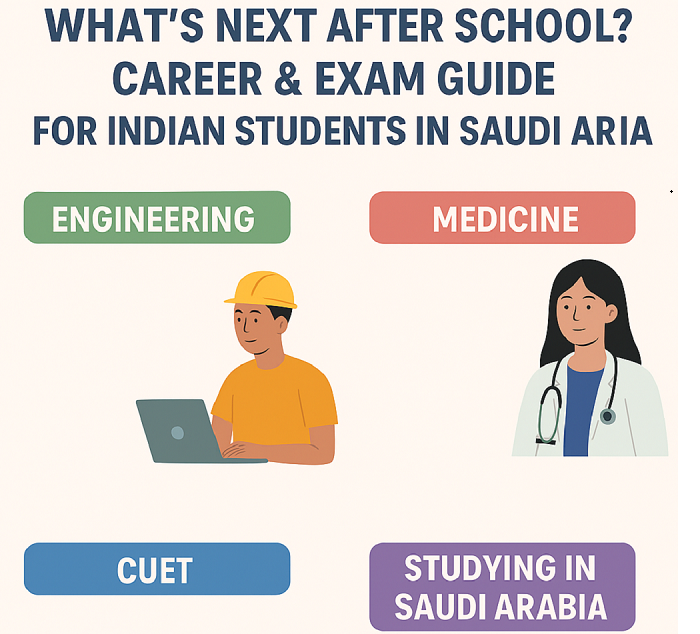
If you’re an Indian student growing up in Saudi Arabia, chances are you (or your parents!) are already thinking hard about what happens after Class 12. Should you prepare for IITs? Try for MBBS in India? Stay back in Saudi for college? Or head out to the US, UK, or Australia?
It’s a big decision, and honestly, the rules and entrance exams can feel like an alphabet soup, JEE, NEET, CUET, DASA, CIWG. Let’s break it all down in simple language so you can see your options clearly.
If your dream is to become an engineer, India offers some of the best colleges in the world, IITs, NITs, IIITs and other Central institutes.
The JEE route: To enter IITs, you need to clear JEE Main (as a qualifying exam) and then JEE Advanced. For NITs and IIITs, JEE Main rank is enough. Even if you study abroad (like in Saudi), you can still sit for JEE, provided you meet the board requirements.
DASA (Direct Admission of Students Abroad): This is a special scheme for students who live outside India (like you in Saudi). It lets you apply to NITs, IIITs, and some top technical universities without competing directly in the general Indian pool.
CIWG (Children of Indian Workers in Gulf): Here’s the cool part, because you’re in Saudi, you may qualify for this quota. CIWG reserves a certain number of seats at NITs and IIITs specifically for Gulf-based Indian kids. It can make getting in a bit easier compared to the hyper-competitive Indian pool.
👉 Action point: If you’re serious about engineering, you need to prepare for JEE Main, because most institutes now require it even under DASA/CIWG.
Always dreamed of wearing a doctor’s coat? Then your keyword is NEET-UG.
Single exam, all of India: NEET is mandatory for MBBS and BDS in India. Doesn’t matter if you’re in Mumbai or Riyadh, if you’re Indian or OCI, you have to clear NEET to get admission.
NRI/OCI quotas: Many medical colleges (especially private ones) keep special seats for NRI students, but they’re usually costlier. Still, they’re a real option if you’ve been studying abroad.
Beyond India: If you don’t make it through NEET or prefer to study abroad, countries like Russia, Georgia, Philippines, and even some European universities admit Indian students. Just remember, to practice back in India, you’ll need to pass the NExT/FMGE exam after your foreign degree.
👉 Action point: If medicine is your goal, focus your energy on PCB subjects and NEET prep right from Class 11.
Not everyone wants engineering or medicine, and that’s perfectly fine. If you want to study Arts, Commerce, Economics, Law, or Sciences, then you should know about CUET (Common University Entrance Test).
It’s a new exam that now decides admissions for many central universities like Delhi University (DU), BHU, JNU, Jamia, and others.
CUET has subject-based tests plus language and general ability sections.
👉 Action point: If you want DU or JNU vibes, CUET is your ticket.
You don’t always have to leave Saudi for higher studies. In fact, the country now has some top-ranked universities that accept international students:
KAUST (King Abdullah University of Science & Technology) is globally respected, especially for research in engineering and sciences.
King Saud University, Alfaisal University, and King Abdulaziz University also offer English-medium programs in business, engineering, and medicine.
Staying in Saudi might mean easier logistics (no visas, less homesickness) and good career prospects in the Gulf job market (think energy, IT, healthcare, and finance).
Many Indian students in Saudi also look westwards. Here’s what you’ll usually need:
SAT/ACT: For US colleges (though some are test-optional now).
TOEFL/IELTS: Proof of English proficiency.
UCAS (UK), direct applications (Canada/Australia): Country-specific systems.
The big advantage? Exposure, global careers, and post-study work permits. The drawback? High costs, unless you win scholarships.
College degrees aren’t the only path. Some alternatives include:
CA/ACCA/CFA/CMA for finance and accounting.
Tech bootcamps in data science, AI, cybersecurity, or web development.
Allied health/nursing programs (high demand in the Gulf).
These are faster, more career-focused, and sometimes cheaper than traditional 4-year degrees.
Whatever path you choose, paperwork can make or break your application. Get these ready early:
Valid passport.
Embassy/consulate certificate of residence (proves you’re an NRI in Saudi).
Parent’s work visa & employment proof (especially for CIWG/DASA).
Class X and XII mark sheets + school leaving certificate.
Standardized test scores (JEE, NEET, CUET, SAT, IELTS, etc.).
If you’re into engineering → JEE + DASA/CIWG is your friend.
If you want medicine → NEET is non-negotiable.
For arts/science/commerce → CUET is the new normal.
You can also study in Saudi universities or go abroad.
Keep your documents ready, especially embassy certificates and parent employment proofs.

