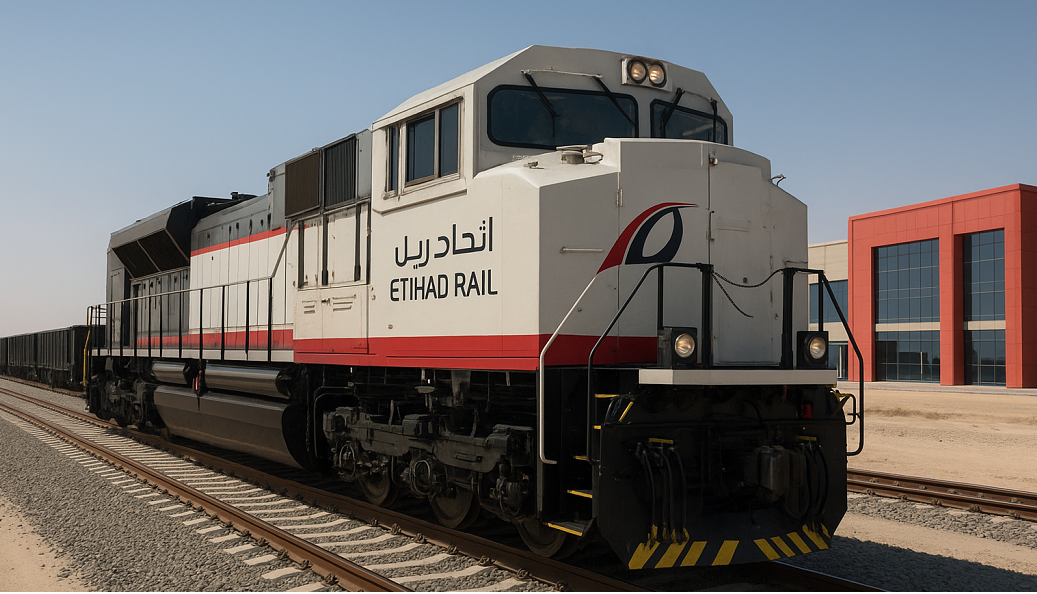
Abu Dhabi, 13 August 2025—The UAE’s transformative rail initiative, Etihad Rail, is fast emerging as a major catalyst for economic and urban development nationwide. Far more than a transport project, experts now describe it as an “economic rewire” for the country, reshaping commercial real estate, industry, and inter-emirate connectivity.
Freight operations: Stage One (264 km from Shah and Habshan to Ruwais) began in 2016; Stage Two (connecting all seven emirates, from Ghuwaifat to Fujairah) completed in 2023, enabling transit across the UAE.
Freight capacity: Expected to reach 60 million tonnes by 2030, with significant reductions in road traffic and CO₂ emissions, while reducing transportation costs and supporting industrial expansion.
Passenger service rollout: Scheduled for 2026, linking 11 cities with integrated metro, bus, and taxi services, featuring NOL card access for unified ticketing.
Speed & coverage: Trains are projected to travel up to 200 km/h; a high-speed Abu Dhabi–Dubai line could reduce travel time to as little as 30 minutes.
Inaugural passenger ride: UAE Vice President Sheikh Mohammed took the first ride on the Dubai–Fujairah route in early August, marking a symbolic step toward full passenger operations.
Creating New Hubs
As one real estate executive put it: “Etihad Rail isn’t a train. It’s an economic rewire of the UAE.” The project is already identified as a trendsetter for commercial real estate, logistics, and urban hubs clustering around strategic stations.
Land Value and Investor Sentiment
Property values in areas like Fujairah, Al Dhaid, and Ruwais are already showing upward pressure. Analysts predict 25–30% appreciation over the next 5–7 years, especially for industrial and logistics zones within 3–5 km of major freight terminals.
Firas Al Msaddi, CEO of fäm Properties, emphasizes the shift: “What used to be too far is suddenly next door.” With faster travel, demand is shifting to formerly secondary markets.
Mixed-Use & Transit-Oriented Development
Transit-oriented clusters are expected near station nodes like Sharjah’s University City and Fujairah’s Sakamkam. These developments are foreseen as walkable, mixed-use zones integrating living, working, and leisure.
Investment potential: Freight and passenger services form part of a broader AED 50 billion UAE Railways Program, generating up to 9,000 jobs by 2030.
Broad economic yield: The railway is projected to deliver up to AED 200 billion in economic returns, including benefits from emissions reduction (AED 21 billion), road maintenance savings (AED 8 billion), tourism (AED 23 billion), and public welfare (AED 23 billion) over several decades.
Climate impact: Offering up to 70–80% lower carbon emissions than road transport for equivalent tonnage, the rail system aligns with the UAE’s Net-Zero 2050 ambitions.
Industrial momentum: Enhanced logistics linking ports (Khalifa Port, Jebel Ali, Fujairah) with inland processing, manufacturing, and storage zones supports Operation 300 billion, an industrial growth drive targeting significant GDP contribution by 2031.
Transport sector growth: The UAE’s transport and storage sector has expanded by 9.6% year-on-year, now constituting 5.2% of national output, up from 4.2% in 2021. The rail network is set to further supercharge this trajectory.
| Aspect | Summary |
|---|---|
| Network Status | 900 km of freight lines operational; passenger services launching in 2026 |
| Economic Impact | AED 200B in cumulative benefits including jobs, tourism, and public gain |
| Real Estate | 25–30% value growth anticipated around hubs; new mixed-use developments |
| Connectivity | 11-city coverage; speedy travel (Abu Dhabi–Dubai in 30 mins) |
| Sustainability | Up to 80% reduced emissions vs road; supports Net Zero 2050 goals |
In summary, Etihad Rail is no longer just a railway, it is the backbone of the UAE’s next-generation economy. By compressing distance and time, unlocking new commercial corridors, and advancing sustainability goals, it is set to define how people live, work, and invest across the Emirates.


Need a Nassau Airport Taxi? Our Affordable Nassau Airport Taxi Service offers direct transfers to top resorts, including Atlantis and Paradise Island. Whether you’re headed to Cable Beach or Downtown Nassau, you can expect prompt service and affordable rates for your Private Transfer Nassau Bahamas.